


If you are completely new to cryptocurrency, the first thing you should know is that you are not behind.
Crypto has a language of its own. People talk about wallets, blockchains, private keys, tokens, mining, exchanges, gas fees and smart contracts as if everyone already knows what they mean. For someone seeing these terms for the first time, it can feel like trying to understand a conversation halfway through.
So let’s start at the beginning.
What exactly is cryptocurrency?
Cryptocurrency is a form of digital money that uses cryptography and blockchain technology to record and secure transactions.
That definition sounds technical, but the basic idea isn’t particularly complicated.
With traditional money, your bank keeps a record of how much money you have and what you do with it. If you send money to someone, the bank or payment provider updates its records to show that the money moved from your account to theirs.
Cryptocurrencies work differently.
Instead of depending on one bank or company to maintain the record, many cryptocurrencies use a distributed network of computers to maintain a shared record of transactions. That shared record is generally called a blockchain. Ethereum describes cryptocurrency in similar terms: a medium of exchange secured by a blockchain-based ledger.
This is one of the biggest ideas you need to understand before going further into crypto.
The blockchain is the record. The cryptocurrency is the asset being recorded.
And once that distinction clicks, many other crypto concepts start making much more sense.
Why was cryptocurrency created?
The story begins with Bitcoin.
In 2008, someone using the name Satoshi Nakamoto published the Bitcoin whitepaper, proposing a peer-to-peer electronic cash system. Bitcoin’s network went live in 2009.
The interesting part wasn’t simply creating another form of digital money.
Digital files can be copied. If you sent someone a photo, for example, you would still have your own copy. So how could digital money work without allowing someone to simply copy their coins and spend them twice?
Bitcoin’s answer was to use a public ledger maintained by a decentralized network.
Instead of asking a bank to confirm that you have enough money to make a payment, the network verifies transactions according to Bitcoin’s rules.
That was a major change in how digital payments could work.
So what is a blockchain?
Think about a notebook containing a record of transactions.
Alice sends Bob 0.1 BTC.
That transaction gets recorded.
Bob later sends some Bitcoin to Carol.
That transaction gets recorded too.
As more transactions are confirmed, they are grouped into blocks. Those blocks are connected together, creating what we call a blockchain.
The important thing is that the ledger isn’t simply sitting on one company’s computer. Bitcoin’s blockchain is shared across the network, allowing participants to verify transactions and the state of the system.
This is why the word blockchain comes up so often when people talk about cryptocurrency.
It isn’t just a fancy database.
It is a way of maintaining a shared record without relying on one central authority to control the entire system.
Does cryptocurrency actually exist somewhere?

This is where crypto gets a little strange.
If you own Bitcoin, you can’t open your laptop and find a file called my-bitcoin.txt.
Your Bitcoin isn’t sitting inside your phone.
The blockchain contains the records of transactions and balances. Your wallet contains the cryptographic keys that allow you to control the funds associated with your addresses.
This is why losing access to your wallet can be serious. Bitcoin.org explains that wallets manage the private keys used to spend Bitcoin; the Bitcoin itself exists as records on the blockchain.
That’s also why the phrase “not your keys, not your coins” exists.
If another company controls the keys for your crypto, you are relying on that company to give you access to your funds.
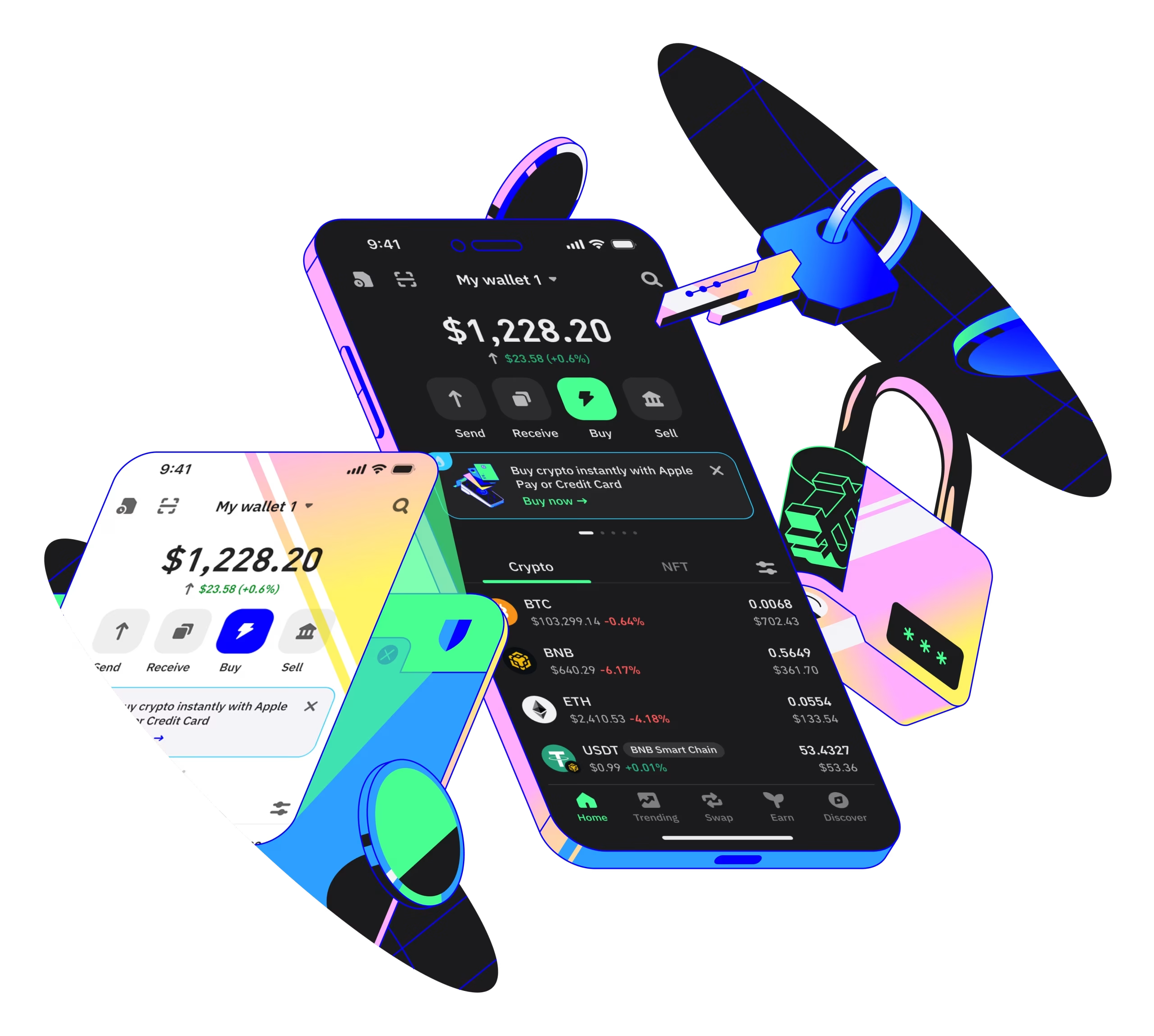
What is a crypto wallet?
A crypto wallet is the tool you use to interact with your cryptocurrency.
Depending on the type of wallet, it might be a mobile application, browser extension, desktop program or physical hardware device.
But there’s an important misconception to get rid of early:
A wallet doesn’t literally store your cryptocurrency.
It stores or manages the keys that allow you to control your assets on the blockchain.
For example, when you receive Bitcoin, someone can send it to your Bitcoin address. Your wallet lets you view the relevant balance and authorize transactions from your address.
This is one reason your wallet’s recovery phrase or private keys must be protected. If someone gets access to them, they may be able to control your funds.
What makes cryptocurrency different from regular money?
There are several differences, but decentralization is probably the most important place to start.
With money held in a traditional bank account, the bank is the intermediary.
With Bitcoin, the network itself processes and verifies transactions according to the protocol’s rules. Bitcoin describes itself as a peer-to-peer network operating without a central bank or central authority.
This can provide some interesting possibilities.
You can potentially send Bitcoin to another person without either of you having an account with the same bank.
The Bitcoin network operates continuously, rather than following normal banking hours. Transactions are recorded on a public blockchain, meaning the transaction history can be independently examined.
But decentralization doesn’t mean crypto is automatically better at everything.
There are trade-offs.
Transactions can be difficult or impossible to reverse once confirmed. Prices can be extremely volatile. And if you control your own wallet, you also take on responsibility for securing your keys.
Crypto gives you more control in some situations, but control comes with responsibility.
Is cryptocurrency anonymous?
Not necessarily.
This is one of the most common misunderstandings about Bitcoin.
Bitcoin transactions are publicly recorded on the blockchain. Anyone can examine the transactions associated with a Bitcoin address.
What isn’t necessarily displayed directly on the blockchain is your real-world name.
So Bitcoin is better described as pseudonymous, rather than completely anonymous.
If an address becomes connected to your identity through an exchange, transaction, public post, or another source of information, activity associated with that address may potentially be connected to you.
Bitcoin.org specifically warns that Bitcoin transactions are public and permanent, while the identity behind an address isn’t automatically displayed.
What are Bitcoin, Ethereum and all the other cryptocurrencies?

Bitcoin was the first cryptocurrency, but it certainly wasn’t the last.
Today there are thousands of cryptocurrencies and tokens operating across different blockchain networks.
And they don’t all serve the same purpose.
Bitcoin (BTC) was designed around decentralized digital money and peer-to-peer payments.
Ether (ETH) is the native cryptocurrency of Ethereum and is used for things including paying transaction fees on the network. Ethereum also supports programmable smart contracts, which opened the door to applications beyond simple payments.
Then there are stablecoins, utility tokens, governance tokens and many other types of crypto assets.
This is why simply saying “crypto” doesn’t tell you very much.
It’s a bit like saying “software.” A video editor, operating system and calculator are all software, but they obviously aren’t designed to do the same thing.
How do people get cryptocurrency?
There are several ways people can acquire crypto.
For Bitcoin, for example, people can receive it as payment, purchase it through a cryptocurrency exchange or peer-to-peer transaction, or earn it through mining.
But acquiring cryptocurrency and understanding cryptocurrency are two very different things.
If you’re new to the space, learning should come first.
Understand how wallets work. Learn what a blockchain actually does. Learn the difference between an address and a private key. Understand transaction fees and confirmation times.
Those basics will save you from a lot of confusion later.
Is cryptocurrency an investment?
Cryptocurrency can be bought and held as an asset, but that doesn’t automatically make every cryptocurrency a good investment.
Crypto prices can move dramatically, sometimes within a very short period. Bitcoin.org itself warns users about Bitcoin’s volatility and recommends not putting money into it that they cannot afford to lose.
There is also a huge difference between learning about an asset and being promised a return from it.
Anyone telling you that a particular cryptocurrency is guaranteed to make you rich should immediately raise your eyebrows.
Crypto is an interesting technology and financial system, but it is not a shortcut to easy money.
Where should a beginner go from here?
If you’ve made it this far, you already understand the most important starting point:
Cryptocurrency isn’t simply “internet money.”
It is a collection of technologies and systems built around cryptography, distributed networks and blockchain-based records.
Bitcoin demonstrated that digital value could be transferred through a decentralized peer-to-peer network.
Blockchain technology provided a way to maintain a shared record of those transactions.
Wallets give users the tools to interact with their assets.
And newer networks such as Ethereum expanded the idea by allowing programmable applications to operate on a blockchain.
There’s still a lot to learn—and that’s actually the fun part.
In the next guide, we’ll take one step deeper and look at how blockchain actually works. We’ll break down blocks, transactions, nodes, consensus and mining without assuming you already have a computer science degree.
Because once you understand the blockchain itself, the rest of crypto becomes considerably easier to follow.
Welcome to LearnTheCrypt.


Leave a Reply