


If Bitcoin introduced the idea of digital money without a bank, Ethereum took the idea in a different direction.
Instead of asking only, “Can we send money without a central authority?”, Ethereum opened up a much bigger question:
“Can we build applications that run without a traditional company controlling the underlying system?”
That question is at the heart of Ethereum.
Today, Ethereum is one of the most important blockchain networks in the crypto ecosystem. It is used for digital assets, decentralized applications, smart contracts, and a large part of the infrastructure behind Web3.
But you don’t need to be a blockchain developer to understand it.
Let’s break it down.

What is Ethereum?
Ethereum is a blockchain network designed to do more than simply transfer cryptocurrency.
Like Bitcoin, Ethereum maintains a distributed blockchain and allows users to send digital assets to one another.
The big difference is that Ethereum is also designed to run programs called smart contracts.
These programs live on the blockchain and can execute according to rules written into their code. Developers can use them to build applications that interact with users and with other smart contracts.
This makes Ethereum less like a digital version of cash and more like a shared computing platform.
You can think of Bitcoin primarily as a decentralized monetary network.
Ethereum is a decentralized network that can support money, programs, and applications.
Who created Ethereum?
Ethereum was proposed by Vitalik Buterin in 2013.
The Ethereum network officially launched in 2015.
The original idea was ambitious: create a blockchain that wasn’t restricted to one particular application.
Rather than building a system where developers had to create an entirely new blockchain for every use case, Ethereum would provide a general-purpose platform where developers could write programs and deploy them onto the network.
That idea eventually became the foundation for much of what we now call Web3.
Ethereum vs ETH: What’s the difference?
This confuses almost everyone at first.
Ethereum is the blockchain network.
Ether (ETH) is the cryptocurrency that belongs to that network.
It’s similar to the distinction between a road and the fuel used by vehicles on it.
Ethereum is the network.
ETH is the native asset that helps power it.
ETH has several roles within the Ethereum ecosystem. It is used to pay transaction fees, participate in network security through staking, and function as an asset within applications built on Ethereum.
So when someone says, “I have Ethereum,” they often technically mean that they own ETH.
What makes Ethereum different from Bitcoin?

The simplest comparison is this:
Bitcoin was designed primarily as decentralized digital money.
Ethereum was designed as a programmable blockchain platform.
That’s not to say Bitcoin can’t do anything beyond payments, or that Ethereum isn’t used as money. Both statements would be too simplistic.
But the original focus of each network is different.
Bitcoin’s scripting system is intentionally limited.
Ethereum provides a much more general environment for running programs.
Those programs are smart contracts.
And smart contracts are where things get interesting.
What is a smart contract?
Despite the name, a smart contract isn’t necessarily a legal contract.
It’s essentially a program that runs on the Ethereum blockchain.
Ethereum’s documentation describes a smart contract as code and data residing at a specific address on the blockchain. Users can interact with the contract by sending transactions that trigger its functions.
Imagine a vending machine.
You put money in.
You select something.
If the conditions are satisfied, the machine performs the programmed action.
There’s no employee standing behind the machine deciding whether to give you the product.
A smart contract works on a similar principle.
Its code defines what happens when certain conditions are met.
For example, a simple smart contract could be programmed to transfer a digital asset when a particular transaction occurs.
Of course, real-world smart contracts can be vastly more complicated.
They can contain financial logic, ownership rules, voting mechanisms, marketplaces and much more.
Why are smart contracts important?
Before blockchains like Ethereum, most online applications relied heavily on centralized servers.
Think about a typical social media platform.
You use the application.
Your information is stored on the company’s servers.
The company controls the software and infrastructure.
If the company changes something, your experience changes.
If the company shuts down the service, you lose access.
Ethereum introduced another model.
Developers can deploy programs to a blockchain where the code and its state can be publicly verified, and users can interact with those programs without the application’s core logic necessarily being controlled by one central company.
That’s the basic idea behind decentralized applications, or dApps.
What are dApps?
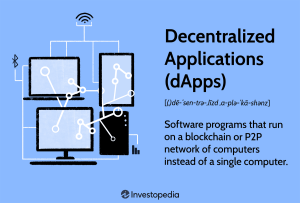
A dApp is a decentralized application.
The exact architecture can vary, but the important part is that blockchain-based smart contracts handle some of the application’s logic.
A decentralized exchange is a good example.
Instead of sending your assets to a traditional company and asking that company to execute your trade, a decentralized exchange can use smart contracts to facilitate trades according to programmed rules.
Other examples include:
- Lending and borrowing applications
- Blockchain games
- NFT marketplaces
- Decentralized finance platforms
- Governance applications
- Token-based communities
Ethereum’s developer documentation lists marketplaces, financial applications and games among the types of applications that smart contracts can support.
And this is where the term Web3 starts appearing.
So what exactly is Web3?
Web3 is a broad term, and people don’t always agree on its exact definition.
But in the simplest sense, Web3 refers to a vision of the internet where blockchain networks can provide ownership, payments and decentralized application infrastructure.
Instead of an application being completely controlled by a company and running entirely on centralized infrastructure, some parts of the system can be handled by blockchain networks and smart contracts.
Ethereum is one of the major platforms associated with this idea.
It’s important not to think of Web3 as “the next version of the internet” that has already replaced everything.
It’s still an evolving ecosystem, and plenty of Web3 applications have trade-offs that traditional applications don’t.
What is gas on Ethereum?
This is one term you’ll encounter almost immediately if you start using Ethereum.
Gas is the unit used to measure computational work on Ethereum.
Whenever you make a transaction or interact with a smart contract, the network has to perform computations.
Those computations require resources.
Ethereum charges for those resources using gas fees, which are paid in ETH.
Think of it as paying for the amount of work the network has to perform.
Sending ETH from one address to another is relatively simple.
Interacting with a complicated smart contract can require significantly more computation.
That means different transactions can require different amounts of gas.
Why do Ethereum gas fees change?
You’ve probably heard people complain about Ethereum gas fees.
There is a reason.
Ethereum has limited block space and network resources. When demand for those resources increases, competition for inclusion in blocks can increase as well.
Ethereum’s fee system includes a base fee and a priority fee. The base fee is determined by the protocol, while the priority fee acts as a tip intended to encourage validators to include a transaction.
This means the cost of using Ethereum isn’t always the same.
A simple transaction during a quiet period can be relatively inexpensive.
A complicated transaction during a period of heavy network activity can cost considerably more.
It’s also worth remembering that Ethereum’s fee environment has changed over time as the network has been upgraded and scaling solutions have developed. So old articles claiming that Ethereum transactions are always extremely expensive can be misleading.
What is the Ethereum Virtual Machine?
Here’s where we get a little more technical.
Ethereum has something called the Ethereum Virtual Machine, or EVM.
The EVM is the environment responsible for executing smart contract code on Ethereum.
You don’t need to understand the EVM to send ETH.
But if you’re interested in becoming a blockchain developer, you’ll eventually need to understand it.
Developers write smart contracts using languages such as Solidity and Vyper. The code is compiled into a form that the EVM can execute.
This is one reason Ethereum is particularly important for developers.
It isn’t merely a cryptocurrency network.
It’s a programmable environment.
How is Ethereum secured?
Ethereum currently uses Proof of Stake.
This is different from Bitcoin’s Proof of Work system.
Instead of miners competing using computing power to produce blocks, Ethereum relies on validators who stake ETH and participate in validating the network.
Validators are responsible for checking blocks and participating in the process of agreeing on the blockchain’s state. Validators who act dishonestly can have some of their staked ETH destroyed, a mechanism known as slashing.
Ethereum switched from Proof of Work to Proof of Stake in September 2022 during an event known as The Merge.
This significantly changed how Ethereum’s network is secured.
What does ETH actually do?
ETH isn’t just another cryptocurrency you buy and watch on a price chart.
It has practical functions within Ethereum.
You use ETH to:
Pay transaction fees
Every transaction that requires Ethereum’s network to perform work requires gas, and gas fees are paid in ETH.
Interact with applications
If you want to use an Ethereum-based application that requires a transaction, you’ll generally need ETH to pay the associated network fee.
Secure the network
Ethereum uses ETH staking as part of its Proof of Stake consensus mechanism.
Transfer value
Like other cryptocurrencies, ETH can also be sent between addresses as a digital asset.
This combination makes ETH fundamentally different from a token that exists solely as a speculative asset.
What does Ethereum have to do with NFTs?
NFTs became one of the most visible applications of Ethereum.
An NFT, or non-fungible token, is a blockchain-based token designed to represent a unique item or asset.
Ethereum’s smart contracts can create and manage these tokens.
That doesn’t mean every NFT is automatically valuable, nor does owning an NFT necessarily mean owning the copyright to an image.
Those are separate questions.
The important point is that Ethereum’s programmable infrastructure made it possible to create standardized token systems that could be traded and interacted with by different applications.
What about DeFi?
DeFi stands for decentralized finance.
It refers broadly to financial applications built using blockchain networks and smart contracts.
Instead of relying entirely on a traditional financial institution, users can interact with protocols that provide functions such as swapping assets, lending, borrowing or providing liquidity.
Ethereum became one of the central platforms for the growth of DeFi.
The underlying idea is fascinating:
A piece of financial logic can be written into software, deployed on a blockchain, and made available to anyone with a compatible wallet.
But there are risks.
Smart contracts can contain bugs.
Users can lose assets through scams or malicious contracts.
Token prices can be extremely volatile.
And decentralized doesn’t automatically mean safe.
Understanding how something works is much more valuable than simply seeing the word “DeFi” and assuming it’s an opportunity.

Is Ethereum completely decentralized?
This question is more complicated than it first appears.
Ethereum is designed as a decentralized network, with many independent participants running nodes and validators.
But decentralization isn’t a simple on/off switch.
There are different aspects to consider: who runs infrastructure, who validates blocks, how software development happens, how much influence different participants have, and how easy it is for ordinary users to verify the network themselves.
So rather than saying “Ethereum is 100% decentralized” and leaving it there, it’s more accurate to understand decentralization as a collection of properties that can be evaluated.
That’s a much healthier way to think about blockchain projects generally.
Why Ethereum matters
Ethereum changed the conversation around blockchain.
Bitcoin showed that a decentralized network could maintain a digital monetary system.
Ethereum demonstrated that the same broad idea could be extended to programmable applications.
That opened the door to smart contracts.
Smart contracts opened the door to dApps.
dApps helped drive the growth of DeFi, NFTs, blockchain gaming and other parts of Web3.
And developers can build all of these systems without creating an entirely new blockchain from scratch.
That’s a pretty significant idea.
The easiest way to remember Ethereum
If you’re trying to keep the whole thing straight, think about it this way:
Ethereum = the network
ETH = the native cryptocurrency
Smart contracts = programs running on the network
EVM = the environment that executes those programs
Gas = the cost of computation
Validators = participants who help secure the network
Once those six pieces make sense, Ethereum becomes much less intimidating.
And if you’re interested in blockchain development, this is where things get particularly interesting.
Because the next step isn’t just learning how Ethereum works.
It’s learning how to actually build on it.
That’s where Solidity comes in.



Leave a Reply